
Emergency Well Pump Repair in Hallsville, TX
Folks around Hallsville and Harrison County, you know as well as I do that getting good, reliable water out of the ground ain’t always a walk in the park. We’re sitting on some tricky geology here in East Texas. You can hit thick layers of red clay that makes drilling a chore, then sandy sections that want to cave in, and often plenty of iron and sulfur to contend with. It’s a real art and science to put in a well and pump that’ll last.
Our primary water source comes from the Carrizo-Wilcox and Queen City-Sparta aquifers. These are sand and clay formations, laid down millions of years ago when this whole region was covered by shallow seas. They’re productive, but that sand can be mighty abrasive on pump parts, and the water frequently carries dissolved minerals like iron and sometimes hydrogen sulfide gas, giving it that distinct ‘rotten egg’ smell.
Now, you might be tempted by a cheap pump from a big box store, but I’m here to tell you, those pumps just don’t stand a chance against what we’ve got going on under Hallsville. The combination of sand, iron scale, and the sheer demand on a residential pump means that flimsy plastic impellers and undersized motors will burn out faster than a match in a hurricane. Investing in a quality pump designed for these conditions saves you a heap of heartache and money in the long run.
Fast Local Service & Diagnostics
Calls are routed to a licensed local well professional.
Well Pump Repair in
Hallsville
Hallsville & Harrison County Well Stats
In Harrison County, residential wells typically range from 200 to 600 feet deep, with some shallower in river bottoms and some deeper on higher elevations. Most wells are drilled into the Carrizo-Wilcox aquifer. Common issues include high iron content (1-5 mg/L), hydrogen sulfide gas, and occasional sand production. Static water levels are generally stable, but can fluctuate with drought conditions. Typical yields are sufficient for residential use, usually 10-20 GPM, but can vary widely.
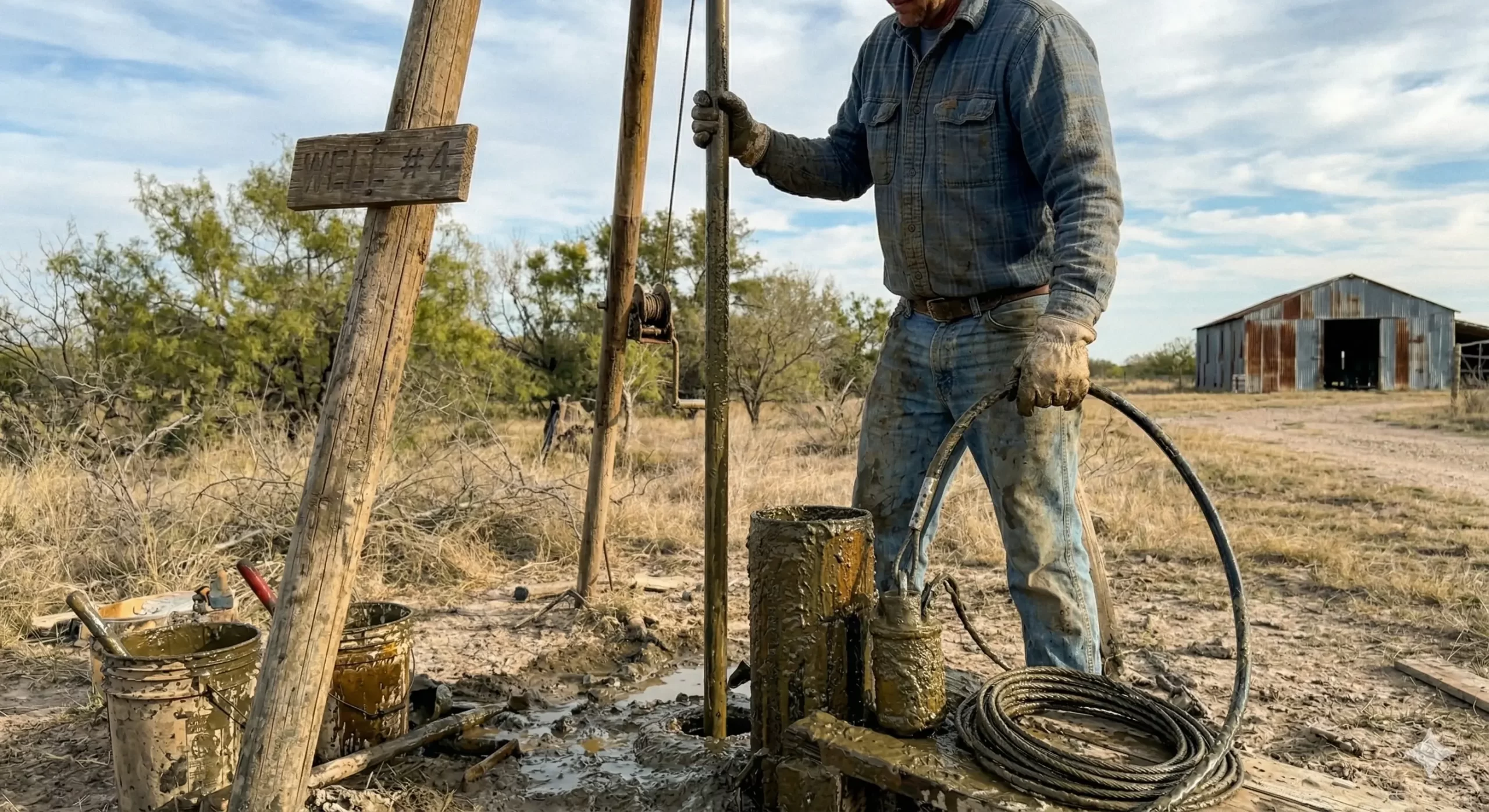
Pulling a pump around Hallsville comes with its own set of challenges, and that directly impacts the cost. While we don’t have the deep bedrock you find out west, we’ve got plenty of tough, sticky clay and consolidated sand layers that can make pulling pipe a real battle. Plus, a lot of our properties are rural, down long, muddy driveways, or nestled back in the woods. Getting a heavy-duty pulling rig into some of those tight, soft spots without tearing up the yard or getting stuck requires skilled operators and specialized equipment.
For a typical pump pull and replacement, we’re bringing out a dedicated well rig or a service truck equipped with a boom and winch system. Depending on depth and pump size, we might need a crane or a full-sized drilling rig. You’ll also need specialized tools like pipe wrenches, submersible pump pullers, electrical diagnostic equipment, and often a well camera to inspect the casing if there are signs of damage or blockage. Factor in the cost of high-quality pipe, wire, torque arrestors, and of course, the new pump itself, and you can see why it’s not a cheap endeavor.
Spring Well Maintenance in Texas
Heavy spring rains can cause surface runoff to breach well caps. We strongly recommend testing your water for coliform bacteria and inspecting the sanitary seal.
Save $500+ on Replacements
Via the TX Energy Co-op VFD Upgrade Program
66°F in Hallsville
Local Aquifers & Geology
The primary groundwater sources in Hallsville include the Carrizo-Wilcox Aquifer. This aquifer system is a major source of groundwater across East Texas, characterized by a series of sands, silty sands, and clay layers. The water quality generally exhibits moderate to high levels of dissolved iron, often requiring filtration. Hydrogen sulfide gas is also commonly present, giving water a ‘rotten egg’ odor. While generally productive, the sandy nature of the aquifer means wells can be prone to sand intrusion if not properly screened and developed.. Drilling through the local Hallsville sits primarily on sandy loams and clay loams, characteristic of the Post Oak Savannah and Piney Woods regions. We see soils from the Bowie, Darco, and Nacogdoches series. Bowie soils are deep, moderately well-drained sandy loams over loamy subsoils. Darco soils are deep, very strongly acidic, poorly drained loamy sands. Nacogdoches soils are deep, well-drained, acidic clay loams. These soils can be challenging for well drilling due to their variable composition, often requiring careful casing and grouting to prevent collapse and surface contamination. means that average well depths range from 250 ft – 550 ft.
Due to these geological factors, local homeowners frequently struggle with Sand abrasion to pump impellers and motors, leading to premature pump failure. The sandy nature of our aquifers means even properly screened wells can pull fine sand over time, especially with inconsistent pumping or declining water levels..
Drilling Depth Comparison
Deeper wells require heavy-duty crane hoists for pump extraction.
Climate & Water Quality
Pump systems in the Hallsville area face severe environmental stressors. The most significant threat is The hot, humid East Texas climate takes a toll on well equipment. High ambient temperatures stress control boxes and pressure switches, leading to premature failure. Frequent, heavy rainfall can lead to localized flooding around wellheads if they aren’t properly sealed and elevated, introducing surface contaminants. Prolonged summer droughts can lower the water table, forcing pumps to work harder and potentially draw more sand or even run dry, causing motor burnout.
Additionally, the raw groundwater often presents issues with High iron content, hydrogen sulfide (rotten egg smell), and fine sand intrusion are prevalent issues that impact water quality and system longevity..
Regional Groundwater Advisory
Known primary contaminant threat to submersible pumps and pipes in this area:
Common Area Systems
VFD Upgrade Savings
Constant Pressure vs StandardReplacing a standard single-speed pump with a Variable Frequency Drive (VFD) eliminates hard starts and drastically reduces energy draw in Texas.
Compliance & Local Permits
Harrison County Level: In Harrison County, new well drilling and major well repairs (like casing replacement) typically fall under the jurisdiction of the East Texas Groundwater Conservation District (ETGCD). You’ll need to register new wells with the ETGCD, and there are often requirements for well spacing from property lines and septic systems. While the district doesn’t issue permits for every minor repair, it’s always best to check their current regulations, especially for new construction or significant modifications. They focus on conserving the local groundwater resources and ensuring proper well construction standards are met.
Top Pump Brands in Texas
Most frequently installed hardware based on local geology (2026 data).
- Check voltage & amperage at the control box and wellhead.
- Inspect pressure tank air charge & bladder integrity.
- Verify pressure switch cut-in/cut-out settings & condition.
- Examine well cap/seal for proper sealing & rodent entry points.
- Test for ground faults or electrical shorts in wiring.
- Perform water sample for basic quality (iron, sulfur, sediment).
Premium Well Pump Brands We Service
Our licensed technicians in Hallsville are certified to repair, replace, and install high-quality groundwater equipment from industry-leading manufacturers, including:
- Low water pressure or inconsistent flow.
- No water coming from the tap.
- Pump cycling on and off too frequently or running continuously.
- Cloudy, sandy, or rust-colored water.
- Strange noises (grinding, humming, knocking) coming from the well or pressure tank.
- Unexpectedly high electric bills.
Hallsville Real Estate Well Regulations
Local Dispatch & Response Times
Live Dispatch: Texas
Updated Just Now⚠️ High demand. Call now to secure the next available technician.
- Typically within 2-4 hours for initial phone assessment and dispatch.
- On-site arrival for emergency ‘no water’ calls is usually 4-8 hours, depending on current workload and travel time.
- Diagnosis and initial repair efforts often begin immediately upon arrival.
- Full pump replacement or major repair can take 1-3 days if parts need to be ordered or specialized equipment is required.
- Factors like severe weather, late-night calls, or remote locations can extend response times.
⚠️ Harrison County & State Regulatory Warning: Abandoned Wells
Groundwater Threat Level
Current aquifer and mineral impact on pumps in Hallsville.
Dropping water tables cause pumps to suck air and overheat.
Hard water calcifies pump impellers, reducing lifespan.
The Cost of Ignoring Symptoms
Fixing a short-cycling pump early saves thousands in Hallsville.
Data reflects average well contractor estimates in Hallsville.
Pump Lifespan Estimator
Select household size in Hallsville to see strain impact.
Local Hallsville
Well Pros
Fast Local Service & Diagnostics
Calls are routed to a licensed local well professional.
Septic System Services in Hallsville, TX
Do you have a septic tank on your property? Proper maintenance is critical to protecting your well water quality.
Hallsville Homeowner Feedback
“My well quit spittin’ water on a Sunday, and these fellas were out here bright and early Monday. Got it fixed up right. Can’t ask for more.”

Local Homeowner
✓ Verified TX
“Had me a submersible pump that was just a’grindin’ itself to death. Water was gritty, and the pressure kept droppin’. Called these fellas out, they pulled it, found the impellers were all chewed up from sand, and the motor was startin’ to go. Replaced it with a heavy-duty one, and now my water’s clear as a bell and strong. Even cleaned out the well a bit. Real pros, knew exactly what was wrong. Thot I’d need a whole new well, but they saved me a bundle. Highly recomend ’em.”

Local Homeowner
✓ Verified TX
“No water this morning, panic set in! Called them up, and they had a tech out here quicker than I expected. He diagnosed the problem fast, had the part on his truck, and had us back in business before lunch. Absolute lifesavers!”

Local Homeowner
✓ Verified TX
Expert Hallsville Well System FAQ
Why does my Hallsville well water smell like rotten eggs, especially when it’s hot?
That classic ‘rotten egg’ smell is almost certainly hydrogen sulfide gas, which is very common in the Carrizo-Wilcox aquifer that supplies much of our water around Hallsville. This gas is produced by sulfate-reducing bacteria that thrive in oxygen-deprived environments, like deep within your well or water heater. While generally not harmful in typical concentrations, it’s unpleasant. We often recommend a whole-house filter system, such as an aeration system or a peroxide injection system, to oxidize and remove the hydrogen sulfide. Sometimes, just flushing your hot water heater can help temporarily, as the problem is often exacerbated there.
My pressure tank in Hallsville keeps clicking on and off really fast, and my water pressure isn’t steady. What’s wrong with it?
If your pressure tank is cycling rapidly, it’s a classic sign of a waterlogged tank, meaning the air charge has been lost, or the internal bladder has failed. A pressure tank needs a cushion of air to absorb the water from the pump and maintain steady pressure. Without it, the pump turns on and off with every small demand for water, which quickly wears out the pump motor and the pressure switch. We’d start by checking the air pressure in the tank and inspecting the bladder. If the bladder is compromised, the tank will need to be replaced. Sometimes, a faulty pressure switch itself can cause rapid cycling, so we always check that too.
How often should I test my well water for bacteria and other contaminants in Harrison County?
For folks in Harrison County, I always recommend testing your well water at least once a year for coliform bacteria and nitrates. These are good indicators of potential contamination. You should also test if there are any noticeable changes in taste, odor, or clarity, especially after heavy rainfall or if any repairs have been done to your well or septic system. If you’re concerned about iron, sulfur, or hardness, we can also perform specialized tests for those minerals. Regular testing ensures your family is drinking safe, quality water and helps us catch potential problems early.
Can I get a new well drilled on my property near Hallsville, and what do I need to know about the process?
Absolutely, many properties around Hallsville are suitable for new wells. The first step is to contact the East Texas Groundwater Conservation District (ETGCD) to understand their current requirements for well spacing from property lines, septic systems, and other wells, and to inquire about any necessary permits or well registration. You’ll need to hire a licensed Texas water well driller – never let an unlicensed person drill your well. They’ll help you determine the best location, approximate depth, and expected yield. The process involves drilling, installing casing and screen, cementing/grouting the annular space, and developing the well. It’s a significant investment, so proper planning and hiring a reputable, licensed professional are paramount to ensure a safe, productive, and long-lasting water source.
Hallsville Groundwater Expert AI
What are the specific groundwater regulations, average well depths, and the local conservation district for Hallsville, Harrison County?
Groundwater Information for Residential Water Wells in Hallsville, Harrison County, TX (2026)
As a Senior Hydrogeologist and Texas Groundwater Regulatory Expert, I can provide you with specific information regarding residential water wells in Hallsville, Harrison County, Texas, for the year 2026.
Specific Groundwater Regulations
Unlike many parts of Texas, Harrison County is currently NOT covered by an active Groundwater Conservation District (GCD). This means that local groundwater pumping is not subject to the permitting and spacing rules of a GCD under Texas Water Code Chapter 36. Instead, residential water wells in Hallsville and Harrison County are primarily regulated by state agencies, predominantly the Texas Department of Licensing and Regulation (TDLR) and the Texas Commission on Environmental Quality (TCEQ).
- Texas Department of Licensing and Regulation (TDLR): The TDLR regulates the drilling, completion, and plugging of water wells across the state. All water well drillers and pump installers must be licensed by the TDLR.
- Well Driller Licensing: All drillers must hold a valid Water Well Driller License issued by TDLR (Refer to Texas Occupations Code Chapter 1901).
- Well Registration: All new or significantly altered water wells must be registered with the TDLR within 30 days of completion. The licensed driller is responsible for submitting a "Well Report and Log" (Form 001WI). This report includes crucial information such as well depth, casing details, and geological formations encountered (Refer to Texas Water Code Chapter 35 and 16 Texas Administrative Code (TAC) Chapter 76).
- Construction Standards: Residential wells must adhere to specific construction standards outlined in TDLR rules to protect groundwater quality and prevent contamination (e.g., proper casing, cementing, and wellhead completion). These standards ensure potable water supply and environmental protection.
- Setbacks: While there isn't a GCD with specific well spacing rules, state rules and general best practices dictate setbacks for wells from potential contamination sources. For instance, a water well generally should be a minimum of 50 feet from an impervious property line, 50 feet from a septic tank, and 100 feet from a drainfield or wastewater treatment plant unit. These are often enforced indirectly through local health departments or city ordinances if they exist.
- Texas Commission on Environmental Quality (TCEQ): The TCEQ oversees water quality, permitting for certain types of discharges (e.g., septic systems), and provides guidance on protecting water resources. While they do not directly regulate residential well drilling, their regulations on septic systems and wastewater treatment impact well placement to prevent contamination.
Official Resources:
- TDLR Water Well Driller and Pump Installer Program: https://www.tdlr.texas.gov/wwd/wwd.htm
- TDLR Water Well Drillers and Pump Installers Rules (16 TAC Chapter 76): https://www.tdlr.texas.gov/rules/rules/16076.htm
- TCEQ On-Site Sewage Facilities (Septic Systems) Regulations: https://www.tceq.texas.gov/permitting/ossf/ossf.html
Average Well Depths for Hallsville, Harrison County
Based on historical state well logs and geological conditions in the Hallsville area of Harrison County, residential water wells typically target various sand units within the primary aquifers. An estimated average well depth for a reliable residential water supply in Hallsville is approximately 400 feet. Depths can range significantly from 200 feet to over 600 feet depending on the specific location, the desired yield, and the targeted producing sand within the aquifer system.
Local Conservation District
As previously stated, Harrison County currently does not have a Groundwater Conservation District (GCD). Therefore, there is no specific local GCD that regulates groundwater pumping or well permitting within Hallsville or the broader Harrison County area.
Specific Aquifer Beneath Hallsville
The primary aquifers utilized for residential water wells in Hallsville, Harrison County, are components of the East Texas Aquifer System. Specifically, wells commonly draw from the:
- Queen City-Sparta Aquifer: This shallower system consists of the Queen City Formation and the underlying Sparta Sand.
- Carrizo-Wilcox Aquifer: This deeper and more prolific aquifer system is the most heavily used in East Texas, comprising the Carrizo Sand and the underlying Wilcox Group.
Residential wells in Hallsville will typically target water-bearing sands within these formations, with the Carrizo-Wilcox generally providing higher yields and often better water quality at deeper intervals.
Fast Local Service & Diagnostics
Calls are routed to a licensed local well professional.
Blix
provides official
Emergency Well Pump Repair services for the
Hallsville
area.