
Emergency Well Pump Repair in Whitehouse, TX
Folks out here in Whitehouse, you know the drill. Groundwater ain’t always a simple affair. We’re dealing with East Texas geology, which means a mix of stubborn clays, some sand, and often, well depths that really make a pump work for its keep. Water levels can fluctuate, especially with long, dry summers, putting extra strain on older systems. That’s just the harsh reality of drawing water from the earth in our neck of the woods.
Our lifeline here is primarily the Carrizo-Wilcox Aquifer. It’s a fantastic resource, but it comes with its own quirks. While it generally provides good water, mineral content, particularly iron and manganese, can be a real headache. Sand intrusion, especially in newer or improperly developed wells, is also a common culprit for pump wear and tear.
When folks try to save a buck on a cheap pump or an inexperienced installer, they often pay for it tenfold down the line. Those bargain-bin pumps just aren’t built to handle the iron, sand, or the demanding depths we encounter here. They burn out faster, clog easier, and leave you without water when you need it most. Investing in quality from the start with a reputable brand & experienced service saves you a lot of grief & money in the long run.
Fast Local Service & Diagnostics
Calls are routed to a licensed local well professional.
Well Pump Repair in
Whitehouse
Whitehouse & Smith County Well Stats
Smith County has thousands of private domestic wells. Average yields are generally good, ranging from 5-25 gallons per minute (GPM), sufficient for most homes. Wells typically tap into the Carrizo-Wilcox Aquifer, with depths varying significantly depending on location within the county and local geology, from 200 feet on the eastern edges to over 800 feet further west.
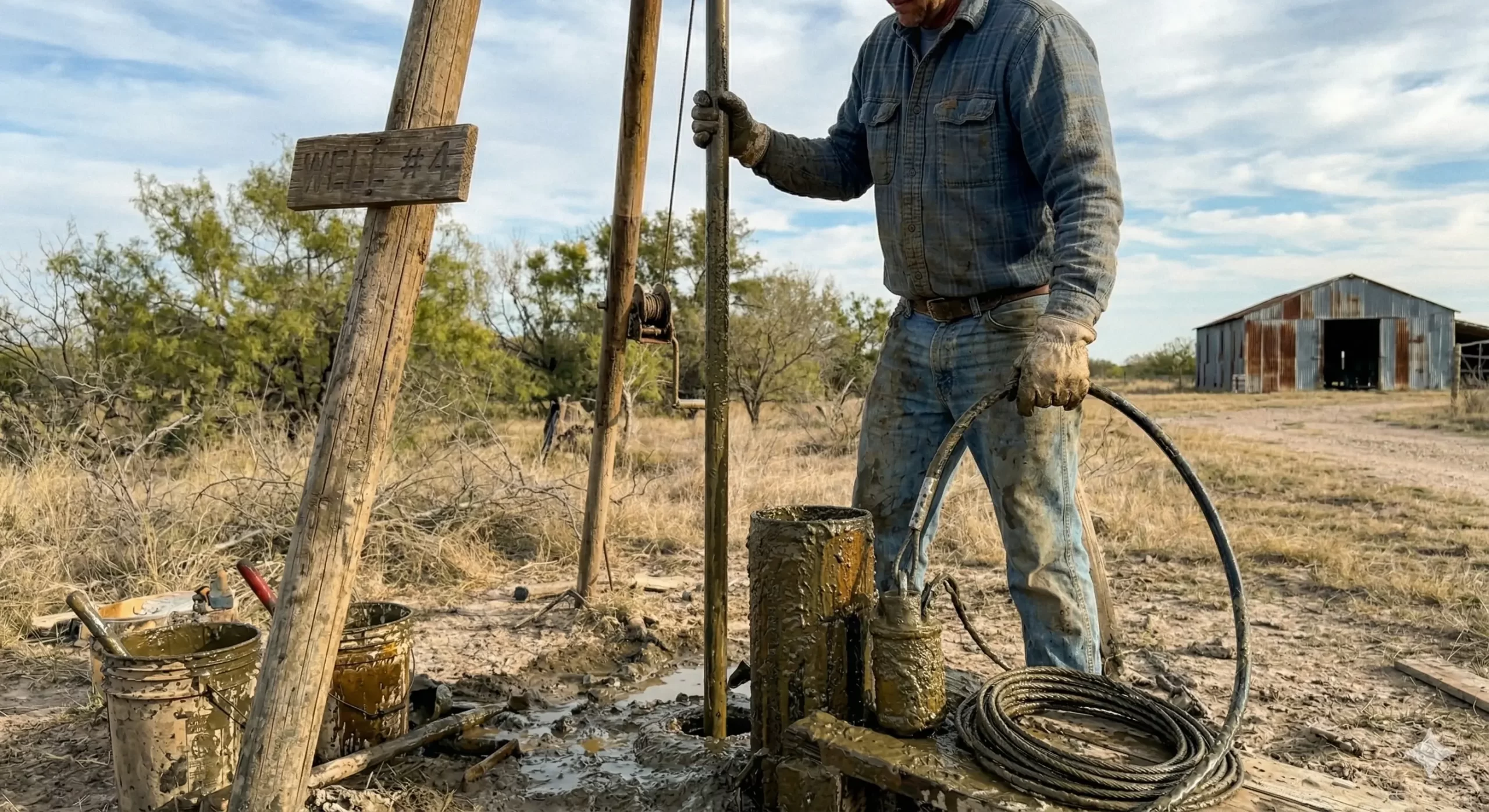
Pulling a pump in Smith County, especially around Whitehouse, can be a significant job. We’re often dealing with well depths ranging from 250 to over 500 feet, sometimes deeper. This means substantial pipe lengths and the pump motor itself sitting deep in the bore. The clay and sandstone layers can make the casing tight, and if a pump’s been down there for decades, it can be truly stuck. Plus, getting a heavy-duty pump rig into some of these rural properties, navigating fences, septic fields, & landscaping, adds to the complexity & time.
We’re not just showing up with a pickup truck and a wrench. A proper pump pull requires specialized equipment: a heavy-duty well rig with a mast & winch system capable of safely lifting thousands of pounds of pipe, pump, & motor. We need pipe wrenches, safety equipment for working with high voltage, and often, diagnostic tools to pinpoint the exact failure before we even start pulling. The right tools & experience prevent damage to your well casing and ensure a safe, efficient repair.
Spring Well Maintenance in Texas
Heavy spring rains can cause surface runoff to breach well caps. We strongly recommend testing your water for coliform bacteria and inspecting the sanitary seal.
Save $500+ on Replacements
Via the TX Energy Co-op VFD Upgrade Program
68°F in Whitehouse
Local Aquifers & Geology
The primary groundwater sources in Whitehouse include the Carrizo-Wilcox Aquifer. This extensive aquifer consists primarily of interbedded sands, silts, & clays. It’s a major source of groundwater in East Texas. The water quality is generally good, but it’s notorious for naturally occurring iron & manganese, which can stain fixtures & cause taste issues. In some areas, localized clay lenses can also trap sulfur, leading to a rotten egg smell. Well development & proper screening are crucial to minimize sand production from these formations.. Drilling through the local Whitehouse sits primarily on sandy loams & deep red clays, characteristic of the Carrizo outcrop areas. These soils are often acidic. Beneath these surface layers, you encounter the sands & shales of the Carrizo-Wilcox group. This soil profile means that wells require proper casing and grouting to prevent surface contamination & stabilize the borehole. The clay content can also make drilling slower & more demanding. means that average well depths range from 300 ft – 600 ft (Can be shallower or deeper depending on specific location & water table).
Due to these geological factors, local homeowners frequently struggle with Sand abrasion and mineral buildup on pump impellers and diffusers. This causes pumps to lose efficiency, draw more power, and eventually fail prematurely. Often exacerbated by poorly developed wells or inconsistent pumping cycles..
Drilling Depth Comparison
Deeper wells require heavy-duty crane hoists for pump extraction.
Climate & Water Quality
Pump systems in the Whitehouse area face severe environmental stressors. The most significant threat is Our East Texas climate is tough on well equipment. Prolonged summer heat stresses pump motors & control boxes, reducing their lifespan. Heavy rains, especially during spring & fall, can lead to surface water infiltration if wellheads aren’t properly sealed, potentially introducing contaminants. Occasional hard freezes can damage exposed pressure tanks, pipes, and outdoor electrical components if not adequately protected, leading to bursts & loss of pressure.
Additionally, the raw groundwater often presents issues with Hardness (calcium & magnesium), iron (red/orange staining, metallic taste), & manganese (black staining, off-taste) are the most prevalent. Sulfur (rotten egg smell) is also encountered. Sand production, especially in wells that haven’t been properly developed or are in fine-grained formations, is a persistent problem for pump longevity..
Regional Groundwater Advisory
Known primary contaminant threat to submersible pumps and pipes in this area:
Common Area Systems
VFD Upgrade Savings
Constant Pressure vs StandardReplacing a standard single-speed pump with a Variable Frequency Drive (VFD) eliminates hard starts and drastically reduces energy draw in Texas.
Compliance & Local Permits
Smith County Level: Whitehouse falls under the Neches Valley Groundwater Conservation District (NVGCD). All new wells, and sometimes replacement wells, require a drilling permit from NVGCD before construction can begin. There are rules regarding well spacing from property lines and other wells to prevent interference. Existing wells must be registered with the NVGCD. It’s essential to check with the district before any drilling or major well modifications to ensure compliance & avoid penalties.
Top Pump Brands in Texas
Most frequently installed hardware based on local geology (2026 data).
- Verify power supply to control box & pump motor (voltage, amperage draw).
- Inspect pressure tank (air charge, bladder integrity, check for waterlogging).
- Test & calibrate pressure switch (cut-in/cut-out settings, contact condition).
- Check wellhead integrity (sanitary seal, conduit, wiring connections, casing condition).
- Perform a static & pumping water level measurement (if possible & applicable).
- Conduct a flow test & evaluate water quality (sediment, clarity, basic odor).
- Inspect for visible leaks in the system & assess overall plumbing condition.
Premium Well Pump Brands We Service
Our licensed technicians in Whitehouse are certified to repair, replace, and install high-quality groundwater equipment from industry-leading manufacturers, including:
- No water at all, or water only trickles out of faucets.
- Significantly reduced water pressure throughout the house.
- Pump runs constantly or cycles on & off very frequently (short cycling).
- Cloudy, sandy, rusty, or discolored water suddenly appears from your taps.
- Strange noises coming from the well itself, the pressure tank, or the control box.
- Spiking electricity bills without an increase in water usage, indicating an inefficient or failing pump motor.
- Air spitting from faucets when water first starts to flow.
Whitehouse Real Estate Well Regulations
Local Dispatch & Response Times
Live Dispatch: Texas
Updated Just Now⚠️ High demand. Call now to secure the next available technician.
- For complete loss of water, we prioritize calls & aim for same-day service, often within a few hours depending on call volume & technician availability.
- Non-emergency repairs, like low pressure or intermittent issues, are typically scheduled within 24-48 hours.
- We maintain a stock of common parts (pressure switches, capacitors, well seals) to expedite repairs.
- For full pump replacements, we assess the situation & provide an estimated timeline, usually within 1-3 days for ordering specific pumps if not in stock.
- After-hours & weekend emergency services are available, though they may incur an additional service charge.
⚠️ Smith County & State Regulatory Warning: Abandoned Wells
The Cost of Ignoring Symptoms
Fixing a short-cycling pump early saves thousands in Whitehouse.
Data reflects average well contractor estimates in Whitehouse.
Pump Lifespan Estimator
Select household size in Whitehouse to see strain impact.
Groundwater Threat Level
Current aquifer and mineral impact on pumps in Whitehouse.
Dropping water tables cause pumps to suck air and overheat.
Hard water calcifies pump impellers, reducing lifespan.
Local Whitehouse
Well Pros
Fast Local Service & Diagnostics
Calls are routed to a licensed local well professional.
Septic System Services in Whitehouse, TX
Do you have a septic tank on your property? Proper maintenance is critical to protecting your well water quality.
Whitehouse Homeowner Feedback
“Had a well go out on a Sunday. Called ’em up, & they had us fixed by Monday afternoon. Good folks, fair price. Highly recommend.”

Local Homeowner
✓ Verified TX
“Our pump started acting real funny, losing pressure, then the water went plumb out. Called these fellas & they came out quick. Turns out, my old pump had been chewing sand for years and finally gave up the ghost. The tech explained how the impeller was all worn down. They pulled the old one, and it was a mess. Put in a new Grundfos, & now we got better pressure than ever. Worth every penny. Great service, polite and knew their stuff. Couldn’t ask for more from a pump guy.”

Local Homeowner
✓ Verified TX
“Water stopped completely on a hot summer day. Called them in a panic. They understood it was an emergency & got a crew out to us within hours. Didn’t mess around, diagnosed the control box quickly, & had us back in water before sundown. Saved our weekend!”

Local Homeowner
✓ Verified TX
Expert Whitehouse Well System FAQ
Why does my water sometimes have a reddish tint or metallic taste in Whitehouse?
That’s a very common complaint around here, and it’s almost always due to naturally occurring iron & manganese in the Carrizo-Wilcox Aquifer. When water is first pumped from the well, these minerals are often in a dissolved, clear state. However, once the water hits the air in your pressure tank or at your tap, the iron oxidizes, turning reddish-brown, and can cause a metallic taste. While generally not a health concern in the concentrations we see, it can stain fixtures, laundry, & impact taste. We can test your water for iron & manganese levels & recommend appropriate filtration solutions, such as oxidation filters or water softeners designed for iron removal, to get rid of that discoloration & taste.
How often should I test my private well water in Smith County?
For basic safety, the Texas Commission on Environmental Quality (TCEQ) & local health departments recommend testing your well water at least once a year for coliform bacteria (indicators of potential contamination) & nitrates. Given our local geology, it’s also a good idea to test every 2-3 years, or if you notice any changes in taste, odor, or clarity, for specific minerals like iron, manganese, & hardness, especially if you’re experiencing issues with staining or pump wear. If you have an infant in the home, more frequent nitrate testing is advised. We can help you arrange for proper water testing & interpret the results.
What’s the typical lifespan of a well pump in Whitehouse, given our local conditions?
A quality submersible well pump in Whitehouse, properly installed & maintained, can last anywhere from 10 to 20 years, sometimes even longer. However, local conditions significantly impact this. High iron & manganese levels can cause mineral buildup on impellers, leading to decreased efficiency & premature failure. Sand production, even in small amounts, acts like sandpaper on the pump’s internal components, drastically shortening its life. Inconsistent power supply, frequent short cycling of the pump due to a waterlogged pressure tank, & exceeding the pump’s designed capacity (e.g., running too dry) are also major contributors to early pump failure. Regular maintenance & addressing water quality issues can extend your pump’s life.
Can I drill a new well anywhere on my property in Smith County, specifically around Whitehouse?
Not just anywhere, no. While you own your property, the drilling & location of new wells are regulated, primarily by the Neches Valley Groundwater Conservation District (NVGCD). They have specific rules regarding well spacing. This means your new well must be a certain distance from your property lines, septic systems, potential contamination sources, & sometimes even other existing wells (yours or your neighbor’s). The purpose is to protect the aquifer & prevent interference. Before any drilling begins, you must obtain a permit from the NVGCD, & they will review your proposed well location. It’s crucial to consult with a licensed well driller & the NVGCD early in the planning process to ensure compliance.
Whitehouse Groundwater Expert AI
What are the specific groundwater regulations, average well depths, and the local conservation district for Whitehouse, Smith County?
Groundwater Regulations and Residential Wells in Whitehouse, Smith County, TX (2026)
As a Senior Hydrogeologist and Local Groundwater Regulatory Expert for Texas, I can provide precise information regarding residential water wells in Whitehouse, Smith County, Texas, as of 2026.
Local Groundwater Conservation District (GCD)
First and foremost, it's critical to understand that as of 2026, Smith County, Texas, including Whitehouse, is NOT located within an active Groundwater Conservation District (GCD). This means that the primary regulatory authority for the drilling, completion, and plugging of residential water wells falls under the jurisdiction of the state, specifically the Texas Department of Licensing and Regulation (TDLR).
While Texas Water Code Chapter 36 provides the statutory framework for GCDs, counties without an adopted GCD are regulated solely by TDLR for well drilling and construction standards.
Specific Groundwater Regulations for Residential Wells
Since Whitehouse is not within a GCD, the regulations governing residential water wells are primarily established at the state level by the TDLR. These regulations are designed to protect groundwater quality, ensure proper well construction, and prevent contamination.
- Regulatory Authority: The primary regulatory body is the Texas Department of Licensing and Regulation (TDLR). They oversee the licensing of water well drillers and pump installers, and enforce state well construction standards.
- Permitting: While TDLR does not issue permits for individual residential wells (as a GCD might), all water well drilling must be performed by a licensed Texas water well driller. The driller is responsible for ensuring the well is constructed according to state rules and for submitting a "Well Report" (also known as a drillers log) to the Texas Water Development Board (TWDB) and the property owner upon completion.
- Well Construction Standards: These are detailed in 16 Texas Administrative Code (TAC) Chapter 76, which implements Texas Occupations Code Chapter 1901. Key requirements include:
- Proper casing materials and installation.
- Adequate surface completion and sanitary seal (grouting) to prevent contamination from the surface.
- Minimum casing depth and cementing requirements, particularly for protecting aquifers from shallower contaminants.
- Installation of well identification plates.
- Setback Rules: State regulations include specific setback distances to protect wells from potential contamination sources. While exact distances can vary based on specific conditions, common state-mandated setbacks include:
- Minimum of 50 feet from a septic tank or absorption field.
- Minimum of 50 feet from a property line, unless a waiver is obtained from the adjacent landowner.
- Greater distances may be required from sources like feedlots, waste disposal sites, or chemical storage facilities.
It is the responsibility of the licensed driller and property owner to ensure these setbacks are met prior to drilling.
- Well Plugging: Abandoned or deteriorated wells must be properly plugged by a licensed driller to prevent them from becoming conduits for contamination, as per TDLR rules.
Average Well Depths in Whitehouse, Smith County
Based on historical state well logs from the Texas Water Development Board (TWDB) for the Whitehouse area within Smith County, residential water wells typically draw from the Carrizo-Wilcox Aquifer, which is a major aquifer in East Texas. The depth can vary significantly based on local topography and the target water-bearing zone's depth and desired yield.
For a reliable residential water well in Whitehouse designed for consistent household use, you can expect an average well depth of approximately 450 feet. Wells can range from 300 feet to over 600 feet, but 450 feet is a sound estimate for a typical, modern residential installation seeking a good yield from the Carrizo-Wilcox. Shallower wells tapping overlying formations may exist but are often less reliable or productive for long-term residential use.
Specific Aquifer Beneath Whitehouse
The primary aquifer providing groundwater to residential wells in Whitehouse, Smith County, is the Carrizo-Wilcox Aquifer. This aquifer system is a significant source of water in East Texas, composed of interbedded sand, silt, clay, and lignite. While other shallower aquifers such as the Queen City and Sparta, and deeper parts of the Trinity Group (like the Paluxy) may exist, the Carrizo-Wilcox is the most commonly utilized and productive for residential and municipal supply in this specific region.
Official Resources and URLs
- Texas Department of Licensing and Regulation (TDLR) - Water Well Drillers and Pump Installers:
https://www.tdlr.texas.gov/wwd/wwd.htm - TDLR - Search for a Licensed Water Well Driller or Pump Installer:
https://www.tdlr.texas.gov/LicenseSearch/ - 16 Texas Administrative Code (TAC) Chapter 76 - Water Well Drillers and Pump Installers:
https://www.tdlr.texas.gov/rules/wt_ch076.htm - Texas Occupations Code Chapter 1901 - Water Well Drillers and Pump Installers:
https://statutes.capitol.texas.gov/Docs/OC/htm/OC.1901.htm - Texas Water Development Board (TWDB) - Water Data Interactive (for well reports and aquifer information):
https://www.twdb.texas.gov/waterplanning/waterdata/wdin/index.asp - Texas Water Code Chapter 36 (General context for GCDs, though none in Smith County):
https://statutes.capitol.texas.gov/Docs/WA/htm/WA.36.htm
Fast Local Service & Diagnostics
Calls are routed to a licensed local well professional.
Blix
provides official
Emergency Well Pump Repair services for the
Whitehouse
area.